Species Information
Kingdom: Plantae
Phylum: Anthophyta
Class: Dicotyledoneae
Order: Apiales
Family: Apiaceae
Genus: Cymopterus
Species: spellenbergii
Taos Springsparsley - Cymopterus spellenbergii
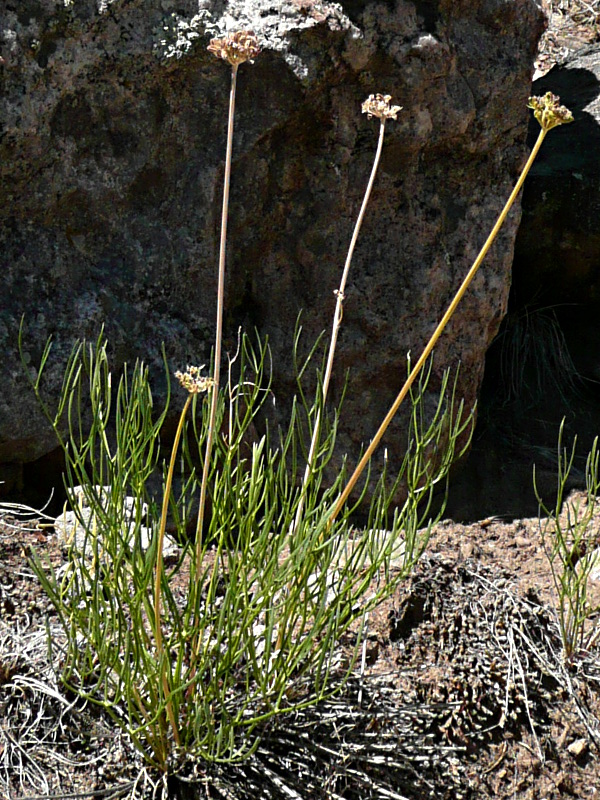
Image courtesy of New Mexico Rare Plants
883879
Species Extent (New Mexico)
General Description
Taprooted, acaulescent, tufted, herbaceous perennial; leaves 1 or more times pinnately compound, ovate or broadly ovoid in outline, 2-6 cm wide, 4-8 cm long, glabrous or minutely scabrous on margins, petioles 1-10 cm long, leaflets sessile, filiform to narrowly linear, ascending, 0.5-7 cm long, often opposite on rachis; inflorescences 1-5(-11+) per plant, peduncles (4-)7-40 cm long, glabrous except sparsely to moderately puberulent at apex with minute peg-like hairs appearing glandular, each peduncle terminated by a convex to globose congested umbel, 2-3.5 cm wide, involucre absent, rays 6-24, 3-8 mm long, lengthening slightly in fruit, umbellets of 4-13 flowers, involucel of 5-7 linear, entire bractlets, 1-3 mm long,
pedicels 1-1.5 mm long, to 3 mm long in fruit; flowers yellow, fading to pale yellow or white, sepals 0.2-0.4 mm long, petals 1-1.2 mm long; fruits tan, terete to somewhat dorsally compressed, broadly ovoid to oblong, not constricted at commissure, 4.8-5.2 mm long, 2.7-2.8 mm wide on commissure, dorsal wings straight, smooth, prominently corky, edges acute to rounded, wedge-shaped to truncate-ovate in cross section, 0.5 mm wide at base, 0.6-0.8 mm tall, the lateral ones often the tallest; mericarps with commissure planar to curved adaxially from the two ends, often with central groove or even cupulate due to enlargement of wings, oil tubes 1 per interval, 2 on commissure, forming ribbons about 0.3 mm wide. Flowers late April to late May; fruits mid May to early July.
pedicels 1-1.5 mm long, to 3 mm long in fruit; flowers yellow, fading to pale yellow or white, sepals 0.2-0.4 mm long, petals 1-1.2 mm long; fruits tan, terete to somewhat dorsally compressed, broadly ovoid to oblong, not constricted at commissure, 4.8-5.2 mm long, 2.7-2.8 mm wide on commissure, dorsal wings straight, smooth, prominently corky, edges acute to rounded, wedge-shaped to truncate-ovate in cross section, 0.5 mm wide at base, 0.6-0.8 mm tall, the lateral ones often the tallest; mericarps with commissure planar to curved adaxially from the two ends, often with central groove or even cupulate due to enlargement of wings, oil tubes 1 per interval, 2 on commissure, forming ribbons about 0.3 mm wide. Flowers late April to late May; fruits mid May to early July.
Status
Global Rank: G2
State Rank: S2
| Rank Metadata | |
|---|---|
| State Rank: S2 | Rank Changed: 02/16/2024 |
| Rank Reviewed: 02/16/2024 | |
| Reason: The calculated rank is S1 based on the narrow range and population size. However the current rank is S2 (ranked 2012). Several new locations (7) have been recently recorded on iNaturalist, indicating that the overall population size is larger than initially thought. About half of the known EOs are also protected in the National Monument. Current monitoring plots indicate stable to increasing populations. Otherwise, species threats still need to be assessed. |
| Ecological Factors | |
|---|---|
| Specificity: Narrow. Specialist or community with key requirements common. | Range Extent: 250-1000 square km (about 100-400 square miles) |
| Occurences: 6 - 20 | Population Size: 2500 - 10,000 individuals |
| Area of Occupancy: Area sums to 4.7 sq km in Biotics. With new localities from iNaturalist and SEINET, I am rounding up and estimating 6 sq km. | Threat Summary: N/A |
State Status: E
Observations in Natural Heritage New Mexico Database
Number of Subpopulations: 28
Number of Mapped Locations: 743
Number of Observations: 884
Observation date range: 05-31-1978 to 08-10-2022
External Links
View More Information about this species at:
NatureServe Explorer
New Mexico Rare Plants Website
Environmental Conservation Online System (ECOS)
NatureServe Explorer
New Mexico Rare Plants Website
Environmental Conservation Online System (ECOS)