Species Information
Kingdom: Plantae
Phylum: Anthophyta
Class: Dicotyledoneae
Order: Fabales
Family: Fabaceae
Genus: Astragalus
Species: siliceus
Flint Mountains Milkvetch - Astragalus siliceus
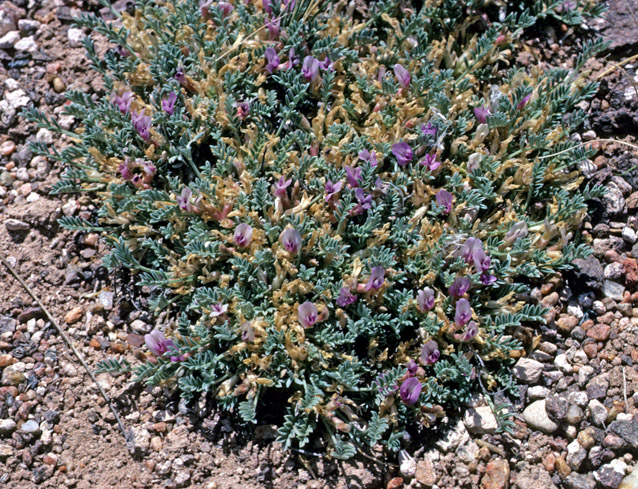
Image courtesy of New Mexico Rare Plants
514315
Species Extent (New Mexico)
General Description
Densely tufted and matted perennial from an intricately branching subsurface caudex; above ground stems absent or less than 2 cm long; leaves crowded, silvery-canescent with mostly appressed dolabriform hairs, pinnately 5-9 foliolate, to 3 cm long, the leaflets elliptic; racemes 1 to 3-flowered, short, not exceeding the foliage; flowers pea-like, pale lavender to vivid pinkish-purple, 10-12 mm long; pods ascending or spreading, ovoid, 5.0-7.5 mm long, slightly compressed from the sides. Flowers in May.
Status
Global Rank: G3
State Rank: S3
| Rank Metadata | |
|---|---|
| State Rank: S3 | Rank Changed: 10/01/1983 |
| Rank Reviewed: 05/19/2025 | |
| Reason: Endemic to NM and with a small range, old data suggest this species is relatively common within its range and responds favorably to disturbance. However, most populations are on private lands, and we are uncertain how the species is doing in the 21st century. The confidence of this rank would improve with more recent surveys. |
| Ecological Factors | |
|---|---|
| Specificity: Narrow. Specialist or community with key requirements common. | Range Extent: 250-1000 square km (about 100-400 square miles) |
| Occurences: 6 - 20 | Population Size: 100,000 - 1,000,000 individuals |
| Area of Occupancy: N/A | Threat Summary: Energy production & mining - Medium - low | Mining & quarrying - Medium - low |
State Status:
Observations in Natural Heritage New Mexico Database
Number of Subpopulations: 16
Number of Mapped Locations: 24
Number of Observations: 31
Observation date range: 05-07-1955 to 04-25-2025
External Links
View More Information about this species at:
NatureServe Explorer
New Mexico Rare Plants Website
Environmental Conservation Online System (ECOS)
NatureServe Explorer
New Mexico Rare Plants Website
Environmental Conservation Online System (ECOS)