Species Information
Kingdom: Animalia
Phylum: Arthropoda
Class: Insecta
Order: Lepidoptera
Family: Nymphalidae
Genus: Argynnis
Species: nokomis nitocris
Southwestern Great Basin Silverspot - Argynnis nokomis nitocris
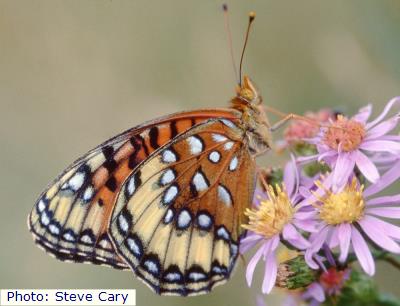
Image courtesy of Biota Information System of New Mexico
1381283
Species Extent (New Mexico)
Status
Global Rank: G3
State Rank: S1
| Rank Metadata | |
|---|---|
| State Rank: S1 | Rank Changed: 02/14/2025 |
| Rank Reviewed: N/A | |
| Reason: The Mogollon Mountains Nokomis Fritillary is a resident to wet marshy meadows in the Gila region of New Mexico.These marshy meadows are a rare habitat in the deserts of the southwestern United States and the Mogollon Mountains Nokomis Fritillary sole host plant requires wet soil or standing water all summer. This habitat is extremely hard to come by now in this region of the world and it appears that this subspecies requires a specific microclimate even within this rare habitat. As a result of climate change, and land use changes relating to water, especially damming, cattle grazing, draining of wetlands, spring capping, and removal of beavers, this butterfly has seen declines resulting in the extirpations of several subpopulations. This decrease in wetland habitat has left the remaining populations of the Nokomis Fritillary (<em>Arynnis nokomis</em>) small and isolated and as a result inbreeding depression runs rampant. The other subspecies of the Nokomis Fritillary have also seen severe declines due to similar threats which have resulted in the extinction of at least one subspecies and <em>A.n. nokomis</em> recently received federal endangered species protections due to the declines it has experienced and is still undergoing. This butterfly is also at great risk from climate change as its host plants require host water all summer extreme droughts can extricate entire colonies and mortality to extreme temperatures and desiccation has been observed in every life stage of the Nokomis Fritillary. The western United States is an area that has recently been seeing unprecedented “megadroughts” which are expected to keep getting worse into the future; this puts the continued existence of this butterfly in jeopardy. A climate change assessment done by the United States Fish and Wildlife Service on the ten remaining populations of <em>A.n. nokomis </em>found that by 2050 with just a moderate amount of climate change and without conservation attention that four of the currently known populations would go extinct and five others are likely to be in bad condition with just one potentially staying in moderate condition. This could easily spell extinction for this subspecies before the end of the century. We expect this to be the same for the Mogollon Mountains Nokomis Fritillary where similar declines have been observed and similar warming and drying trends are expected. This butterfly is also affected by a variety of other threats including, flooding, wildfire, and landslides which can easily extirpate entire colonies which due to their isolation are unlikely to ever be recolonized. Additionally, studies of the subspecies in Nevada found that 88% of the populations of the Nokomis Fritillary there have disappeared and found cattle grazing to be the main cause which is rampant across the western United States. The United States Fish and Wildlife Service has also noted that a minimum of twelve acres of suitable habitat would be needed for a resilient population of <em>A.n. nokomis</em> to exist which is likely similar for the Mogollon Mountains Nokomis Fritillary. Many of the remaining known occurrences are on patches smaller than the twelve acre minimum and as such these populations are considered to be inviable in the face of climate change unless they receive significant conservation support. As a result, the Mogollon Mountains Nokomis Fritillary is currently assessed as S1 in New Mexico. However, a reassessment should be done if more information becomes available. |
| Ecological Factors | |
|---|---|
| Specificity: Very narrow. Specialist or community with key requirements scarce. | Range Extent: 1000-5000 square km (about 400-2000 square miles) |
| Occurences: 6 - 20 | Population Size: Unknown |
| Area of Occupancy: Using all known occurrence records with the exception of the Bluewater Lake point which is known to be extirpated an Area of Occupancy of 5km2 was calculated on GeoCat. | Threat Summary: N/A |
State Status:
Observations in Natural Heritage New Mexico Database
Number of Subpopulations: 1
Number of Mapped Locations: 1
Number of Observations: 1
Observation date range: 06-29-2017 to 06-29-2017
External Links
View More Information about this species at:
Biota Information System of New Mexico (BISON-M)
NatureServe Explorer
Environmental Conservation Online System (ECOS)
New Mexico State Wildlife Action Plan (NMSWAP)
Biota Information System of New Mexico (BISON-M)
NatureServe Explorer
Environmental Conservation Online System (ECOS)
New Mexico State Wildlife Action Plan (NMSWAP)